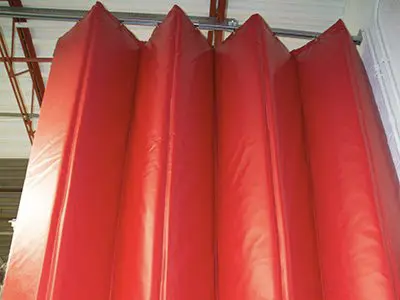
AmCraft Manufacturing offers insulated warehouse curtains and insulated curtain walls that cut energy costs while creating reliable temperature zones quickly. With the ability to be tailored in size, shape, and length, you can select the ideal performance for your space with R-values ranging from R-4/R-5 to R-10/R-12, R-16, and R-25, supporting temperature differentials from 22°F up to 60°F. Proudly Made in the USA, our retractable, flexible, and rigid insulated curtain walls are custom-made for quick installation, tight edge sealing, and easy access—so you can boost efficiency without the expense of fixed construction.
Lower energy costs: Create temperature zones that reduce HVAC or refrigeration run time and energy loss, delivering measurable savings and faster ROI.
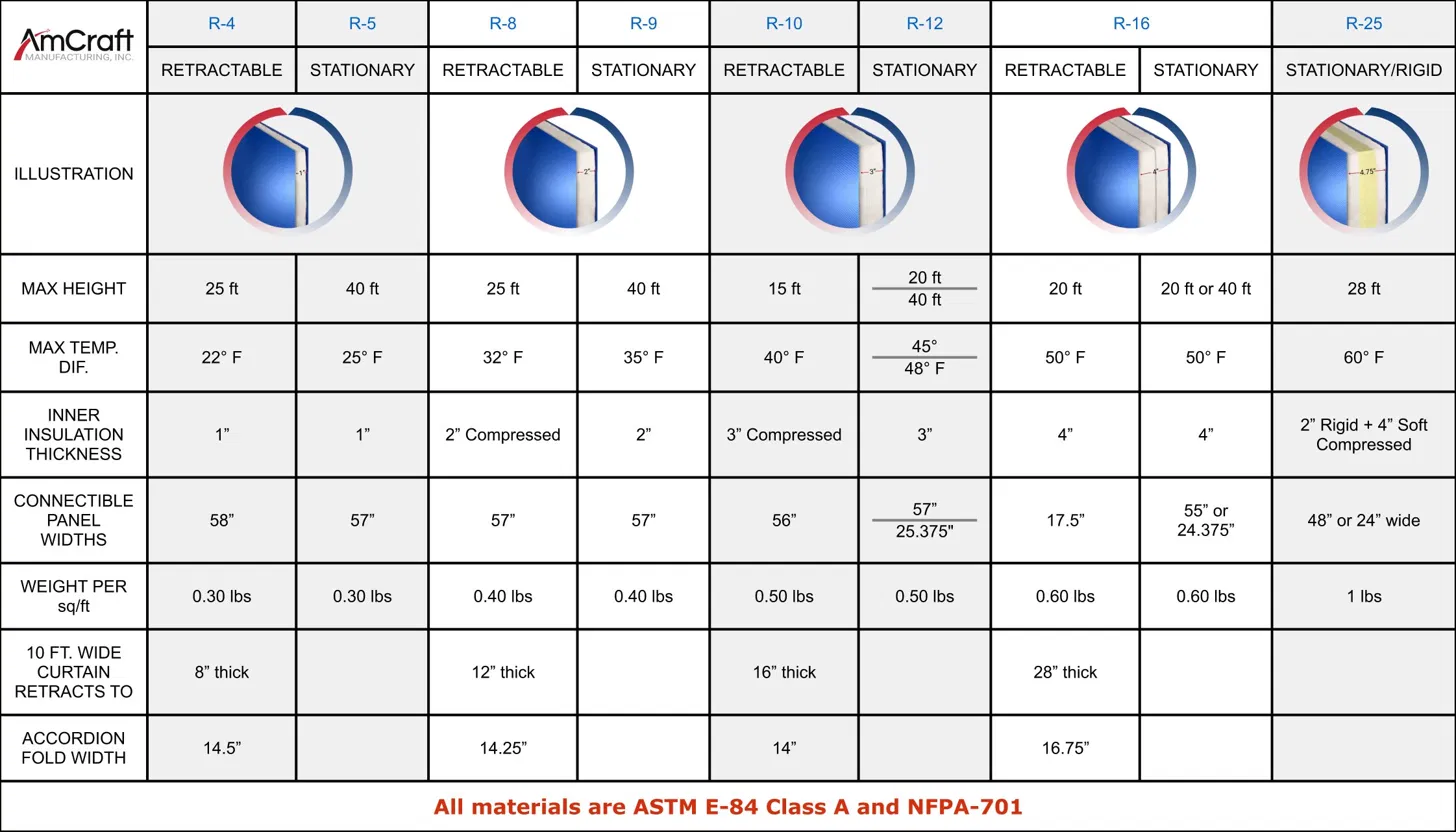
Precise climate separation: Maintain distinct environments with temperature differentials from about 22°F up to 60°F, depending on the selected R-value.
Flexible access and reconfiguration: Track-mounted panels retract for frequent access and can be reconfigured or expanded as operations evolve.
Right-sized performance with high R-values: AmCraft offers insulated warehouse curtains and insulated curtain walls from R-4/R-5, R-8/R-9, R-10/R-12, and R-16 to R-25 to match your specific thermal goals.
Noise Control: Provides limited noise control. Learn more about our Acoustic Curtains for improved performance!
Excellent workmanship: Industrial-grade materials, lock stitch, and precision sewn or RF-welded seams deliver long-lasting performance backed by AmCraft Mfg’s proven fabrication quality.
Buy Direct from the Manufacturer: With sales and manufacturing all in one location, AmCraft controls every step of the process. That means fewer delays, consistent high-quality products, and answers when you need them, real-time, no runaround.
Industrial applications for insulated curtain walls and insulated thermal panels include (but are not limited to):
Warehouses: Use insulated warehouse curtains to create dedicated climate zones within large facilities without permanent construction, improving energy efficiency and workflow.
Storage and Work Spaces: Isolate processes or staging areas to limit heat/cold loss, control dust, and protect temperature sensitive materials with insulated curtain walls.
Food Storage Facilities: Maintain temperature stabilization for a variety of food types, maintaining compliance and product quality standards.
Walk-in Coolers and Freezers: Add interior partitions or vestibules to reduce air exchange at doors, improve door opening recovery times, and cut refrigeration run time.
Refrigerated Trucks: Create modular bulkheads or compartments inside trailers to segment loads by temperature and reduce fuel consumption during deliveries.
Cold Storage Freezers: Partition large freezer rooms into right sized zones to minimize infiltration, protect inventory, and support consistent, low-temperature set points.
Logistics and Distribution Centers: Improve dock efficiency and temperature stability in high-traffic environments by isolating loading, staging, and fulfillment areas, minimizing air loss while keeping goods moving.
Insulated warehouse curtains retain the climate requirements necessary to store and produce temperature-sensitive products. The insulating divider curtains AmCraft manufactures can be installed within a matter of days and are available at a fraction of the cost, providing industrial facilities, plants, and factories with the benefits that save both time and money.
R-value measures the thermal resistance of construction materials, serving as the primary indicator of how well materials prevent heat and cooling loss. In the context of thermal curtain wall structures and industrial curtain enclosures, R-value ratings provide a clear, numerical representation of insulation effectiveness. The scale starts at 1, indicating minimal insulation, and can exceed 35, which is widely regarded as a benchmark for well-insulated, permanent structures.
To determine the appropriate R-value, it’s crucial to assess the customer’s specific needs and the desired temperature differential. This understanding allows us to present the best options to design a customized temperature control warehouse curtain system that meets the unique space requirements.
AmCraft provides efficient climate control solutions with our expertly crafted insulated warehouse curtains and curtain walls. Our commitment to quality and customization ensures unparalleled performance and satisfaction.
In industrial settings, “thermal” is a broad term, while insulated warehouse curtains and insulated curtain walls specify measurable R-values for predictable performance. If you need defined temperature separation and energy savings, choose insulated systems with the right R-value for your target differential.
Yes. Properly engineered insulated warehouse curtains with edge sealing and floor sweeps reduce air infiltration and heat loss, helping maintain stable setpoints. Depending on the R-value selected (R-4/R-5 up to R-25), they can support approximately 22°–60°F of temperature separation.
For many facilities, yes—insulated curtain walls create temperature zones only where needed, cutting HVAC or refrigeration run time and lowering utility costs. They install faster and cost far less than permanent construction, can be reconfigured as operations change, and often deliver a rapid return on investment.
Multi-layer insulated curtain walls with defined R-values and robust edge sealing perform best. Select thickness and construction to match your goal: soft wall (R-4/R-5 to R-12) for moderate differentials, semi-rigid (R-16) for higher separation, or rigid panels (R-25) when you need the greatest thermal performance.
AmCraft manufactures industrial insulated curtains meant for large-scale manufacturing applications. While projects can vary greatly in scale, we do not provide services for small-scale applications, such as in a home or a room in a house.
Depending on the R value that you need to meet, insulation thickness ranges from 1″ thick to 6″ thick. These thicknesses are measured before the insulation is encased in the vinyl curtain shell. Due to the way that these curtains are made, some of the insulation may be slightly compressed when fully enclosed in the sewn and radio frequency welded outer layers of the curtain.
Two essentials determine success: sealing the space and sizing the supply air. First, make the enclosure as airtight as possible—use floor sweeps at the bottom, Velcro edge seals on the sides, and filler panels with valances at the top—to eliminate gaps and limit infiltration. Second, optimize the conditioned air you deliver: both the supply temperature and the airflow rate (CFM) strongly influence how quickly and reliably you can reach and maintain your target temperature. Together, a tight envelope and properly sized airflow produce the most consistent results.
Unfortunately, we cannot. Our expertise is limited to the curtain walls that we fabricate, and we cannot advise on HVAC systems or requirements. We would highly recommend that you work with an experienced mechanical contractor or HVAC engineer to determine the air input needs of your space.
We offer 4 different thicknesses of retractable curtains and 5 different thicknesses of stationary curtains. These options offer temperature differences between 22° and 60°, depending on the thickness of the curtain.We offer 4 different thicknesses of retractable curtains and 5 different thicknesses of stationary curtains. These options offer temperature differences between 22° and 60°, depending on the thickness of the curtain.
Our thinner insulated curtain options are typically priced mid‑market. For thicker, higher‑R, extra‑tall, or retractable systems, we offer capabilities many manufacturers don’t, so direct one‑to‑one price comparisons are uncommon. Beyond price, customers choose AmCraft for build quality, attention to detail, dependable lead times, and responsive, expert support. We’re happy to provide an itemized quote to match performance with your budget.
With proper use and basic maintenance, insulated warehouse curtains typically deliver 10+ years of service life. In favorable conditions, many installations continue performing well beyond a decade, and some have exceeded 20 years. Actual lifespan depends on factors like traffic, cleaning/chemical exposure, temperature extremes, and how well the system is sealed and supported.
Yes. Our insulated warehouse curtains include an industry‑leading 6‑year warranty on materials and workmanship. For full terms and coverage details, we’ll provide a written warranty with your quote.
AmCraft offers several egress options. Which option best fits your needs depends on the size of the egress, what will be moving through the doorway, and the project’s budget. Our most common egress options are a retractable curtain, which can be moved to the side, or a strip door within their curtain wall. You can find all egress options on our website, or our sales team will be happy to find the perfect pass-through option for your application.
AmCraft does not install the curtain walls. These systems are made to be very user-friendly. Additionally, each order is shipped with thorough installation instructions. We are also on hand via phone to answer any and all installation-related questions. A majority of our customers install themselves, or have an in-house crew or contractor that installs these. We also offer installation references through our installation partner companies, which are spread out within the United States. Our Sales Team will make sure we find the best Installer for your facility and location.
Yes, the Insulated Curtains can be used outside. It is important that your sales associate knows that you plan to use this outside, so that they can suggest modifications to the construction, if necessary. Please note that while the Insulated Curtains can be used outdoors, we cannot warranty them. This is because we cannot control the outdoor elements that the curtains will be exposed to. Wind, water, and direct sunlight can be harsh on the sewn construction and PVC vinyl outer layers of the Insulated Curtains.
R-Value is a heat/cold flow resistance measurement. R value, as defined by standard ASTM C168, is: “Resistance, thermal, n: the quantity determined by the temperature difference, at steady state, between two defined surfaces of a material or construction that induces a unit heat flow through a unit area.” Basically, R-Value measures the resistance to heat transfer across/through a given barrier. The higher the R-Value of a barrier, the more resistant it will be to a temperature change. Thicker materials have a higher R-Value than thinner materials. That is why AmCraft offers several thicknesses of Insulated Thermal Curtains to offer you the ideal R-Value for your application.